
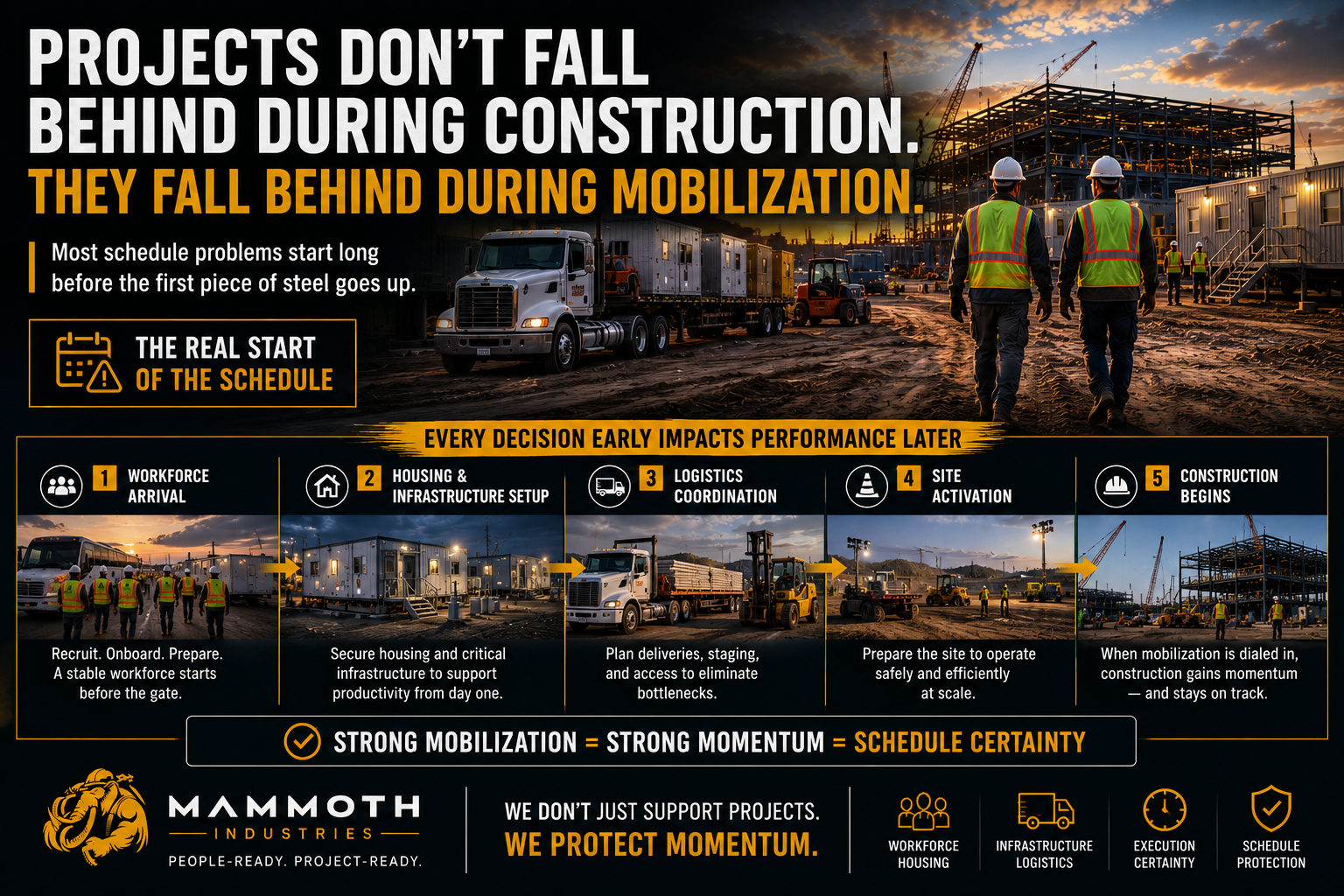
 When data center projects miss schedules, the delay is usually blamed on construction.
But in many cases, the real problem started long before crews entered the field.
It started during mobilization.
The Industry Focuses Heavily on Construction
And understandably so.
Projects invest enormous effort into:
- Design coordination
- Power delivery planning
- Procurement schedules
- Construction sequencing
These are all critical components of large-scale infrastructure delivery.
But increasingly, projects are discovering that execution problems often emerge before vertical construction gains momentum.
Because construction readiness and mobilization readiness are not the same thing.
Mobilization Is Where Execution Risk Begins
A project may have:
- Approved permits
- Utility commitments
- Financing secured
- Construction teams selected
…and still experience major schedule instability.
Why?
Because successful execution depends on operational systems that are frequently underprioritized during early planning:
- Workforce scaling
- Housing availability
- Temporary infrastructure
- Site access and logistics
- Trade coordination
When these systems are incomplete or misaligned, projects begin losing efficiency before meaningful progress is visible.
Small Mobilization Gaps Become Large Schedule Problems
Mobilization failures rarely create one catastrophic event.
Instead, they create dozens of smaller disruptions:
- Labor inconsistency
- Delayed onboarding
- Material congestion
- Productivity loss
- Coordination breakdowns
Over time, these issues compound.
Schedules begin slipping quietly before leadership teams fully recognize the exposure.
By the time delays become measurable in the field, recovery is already expensive.
The Best Projects Build Momentum Early
Leading projects increasingly recognize that early operational readiness determines downstream performance.
That means mobilization is no longer viewed as a support phase.
It is part of the critical path.
The projects that maintain schedule certainty typically align:
- Workforce strategy
- Logistics planning
- Temporary infrastructure
- Site operations
…before major construction ramps up.
This creates something more valuable than readiness.
It creates momentum.
The Bottom Line
Construction doesn’t usually create schedule problems.
It exposes them.
And many of those problems begin during mobilization—when execution systems are still forming.
The projects that outperform over the next decade will likely not be the ones that simply build fastest.
They will be the ones that establish execution certainty earliest.
Because ultimately:
Momentum is created before construction begins.
At Mammoth Industries, we help support execution-ready projects by aligning workforce housing and infrastructure logistics with the realities of early-stage mobilization—protecting schedules before delays take hold.