
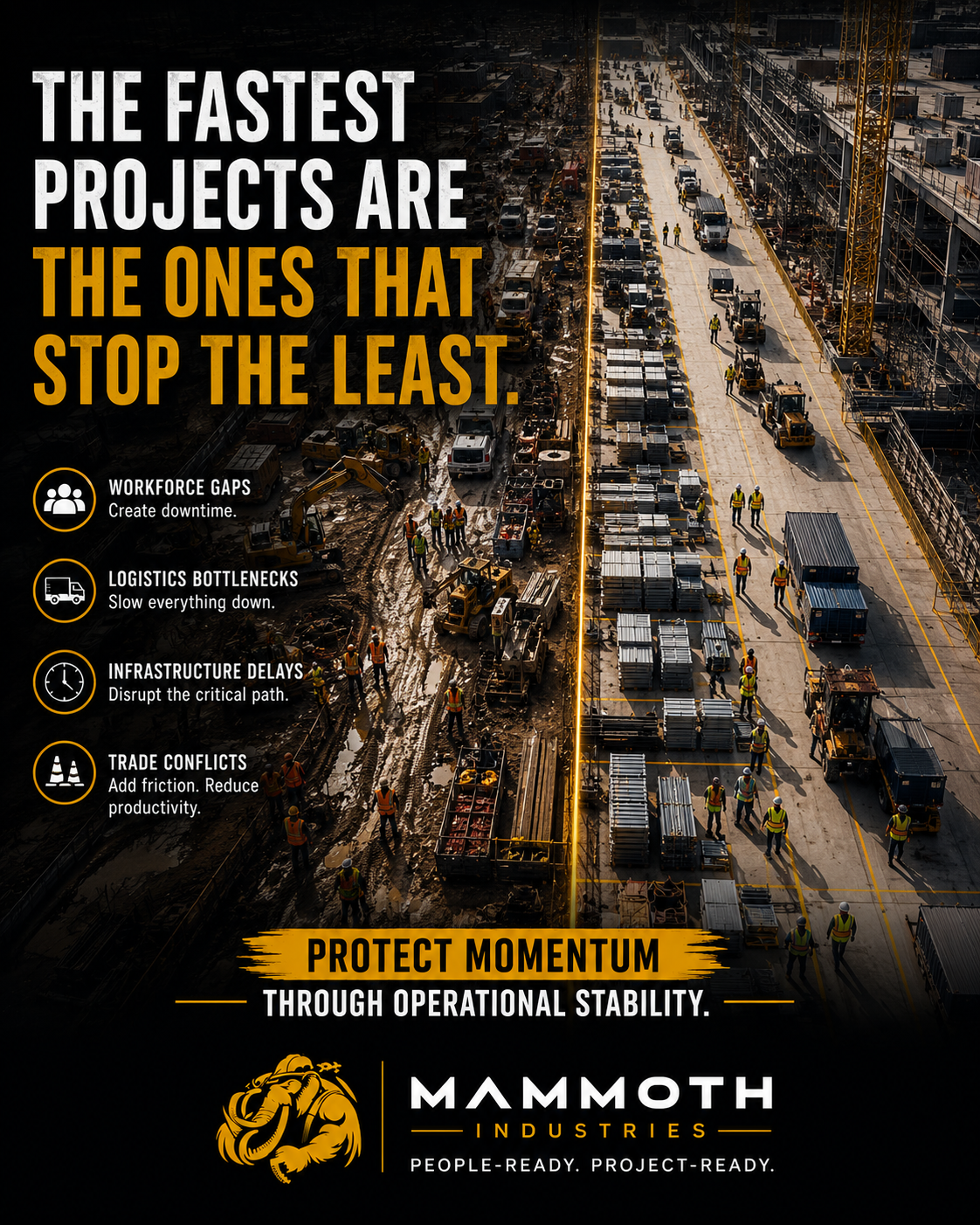
 In large-scale construction, speed is often misunderstood.
Project teams frequently focus on acceleration:
- faster schedules
- compressed timelines
- aggressive sequencing
- increased labor deployment
But many projects that begin aggressively still struggle to finish efficiently.
Why?
Because project success is rarely determined by how fast momentum starts.
It’s determined by how consistently momentum is maintained.
Construction Doesn’t Usually Slow Down All At Once
Schedules typically erode gradually through operational instability:
- workforce inconsistency
- delayed mobilization
- infrastructure gaps
- logistics bottlenecks
- trade interference
Individually, these disruptions may seem manageable.
Collectively, they create constant friction that reduces productivity and destabilizes execution.
This creates a dangerous cycle:
- Momentum slows
- Recovery pressure increases
- Sequencing becomes more aggressive
- Operational instability worsens
The result is often more activity—but less efficiency.
Consistency Is an Operational Advantage
The best-performing projects rarely feel chaotic.
They create stable execution environments where:
- workforce continuity is protected
- logistics remain predictable
- infrastructure support stays aligned
- trades operate efficiently without constant interruption
This allows projects to maintain productive flow over long durations.
And productive flow—not bursts of speed—is what protects schedules.
The Industry Often Rewards Acceleration Instead of Stability
Construction culture frequently celebrates urgency:
- faster deployments
- compressed timelines
- rapid scale-up
But acceleration without operational alignment often creates more disruption later.
Because every recovery cycle introduces:
- coordination pressure
- workforce fatigue
- sequencing instability
- increased cost exposure
The projects that outperform over time are usually not the most aggressive.
They are the most stable.
Stability Creates Momentum
Momentum in construction is not created by intensity alone.
It is created through:
- operational coordination
- workforce readiness
- logistics consistency
- infrastructure support
- minimized disruption
This is where execution certainty begins.
Not with speed.
With stability.
The Bottom Line
The fastest projects are rarely the ones moving the hardest every day.
They are the ones that lose the least momentum over time.
Because in modern infrastructure development:
Consistency scales better than chaos.
At Mammoth Industries, we support execution-ready projects through workforce housing and infrastructure logistics designed to reduce operational friction, stabilize execution, and help projects maintain momentum from start to finish.