
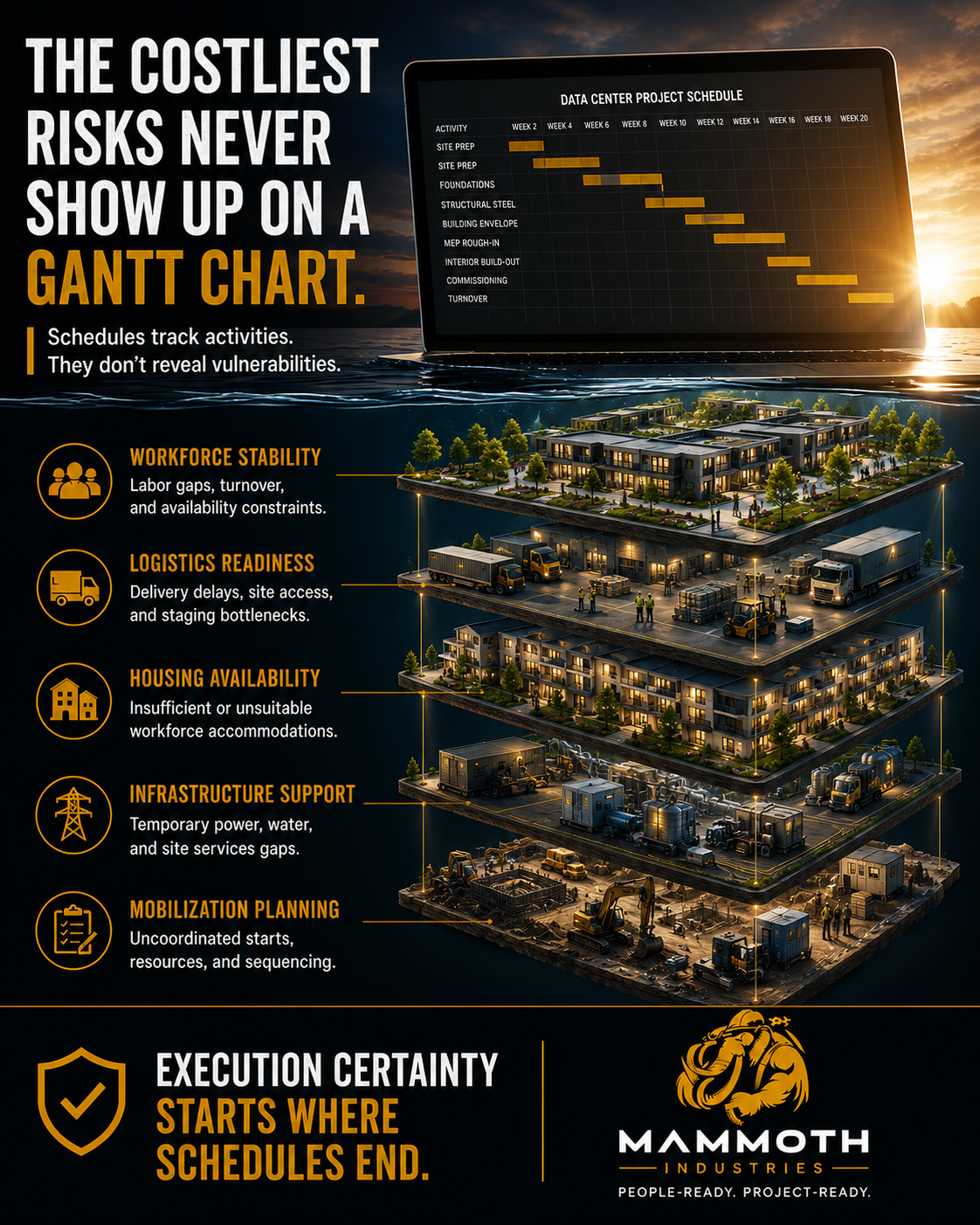
 Construction schedules are powerful tools.
They help teams coordinate work, manage resources, and track progress toward major milestones.
But they have a limitation.
They only measure what has already been identified.
And some of the most significant risks affecting modern infrastructure projects don’t appear on a schedule until it’s too late.
The Difference Between Visible Risk and Operational Risk
Most project teams are highly effective at managing visible risks:
- Procurement milestones
- Utility coordination
- Permit timelines
- Construction sequencing
These activities are measurable, trackable, and regularly reviewed.
But operational risks often develop outside traditional project controls.
Examples include:
- Workforce instability
- Housing shortages
- Logistics congestion
- Mobilization inefficiencies
- Temporary infrastructure gaps
These risks rarely appear as immediate schedule impacts.
Instead, they accumulate slowly until they begin disrupting execution.
Why Hidden Risks Are So Expensive
The challenge with operational risk is timing.
By the time a workforce issue affects productivity…
By the time logistics delays impact sequencing…
By the time housing limitations affect labor availability…
The project is already reacting.
Recovery becomes more expensive because the issue is no longer preventative.
It’s corrective.
And corrective action is almost always more costly.
Schedule Certainty Starts Before Scheduling
Many teams think of schedule protection as a scheduling exercise.
But the strongest projects recognize that schedule certainty begins much earlier.
It begins with operational readiness.
That includes:
- Stable workforce access
- Housing availability
- Infrastructure support
- Coordinated logistics
- Effective mobilization planning
These factors create conditions where schedules can actually perform as intended.
Without them, even the most detailed schedule becomes vulnerable.
The Industry’s Next Competitive Advantage
For years, project advantage was driven by access to land, power, and capital.
Those remain important.
But as projects become larger and more complex, execution quality is becoming the differentiator.
The organizations that consistently outperform are often the ones that identify risk earliest.
Not after delays begin.
Before they start.
The Bottom Line
Gantt charts are valuable.
But they only tell part of the story.
Many of the risks that ultimately impact project performance are operational risks that develop long before they appear on a schedule.
The most successful projects don’t simply manage milestones.
They proactively eliminate the hidden friction that threatens them.
Because the costliest risks are often the ones nobody sees coming.
At Mammoth Industries, we help create execution-ready projects by aligning workforce housing and infrastructure logistics to reduce operational risk, protect momentum, and improve schedule certainty.