
 Data center construction has never been more sophisticated.
Power delivery is modeled years in advance.
Equipment lead times are tracked with precision.
Permitting timelines are carefully managed.
And yet—projects are still missing schedules.
Not because these systems are failing.
Because something else is.
The Industry Is Solving the Wrong Critical Path
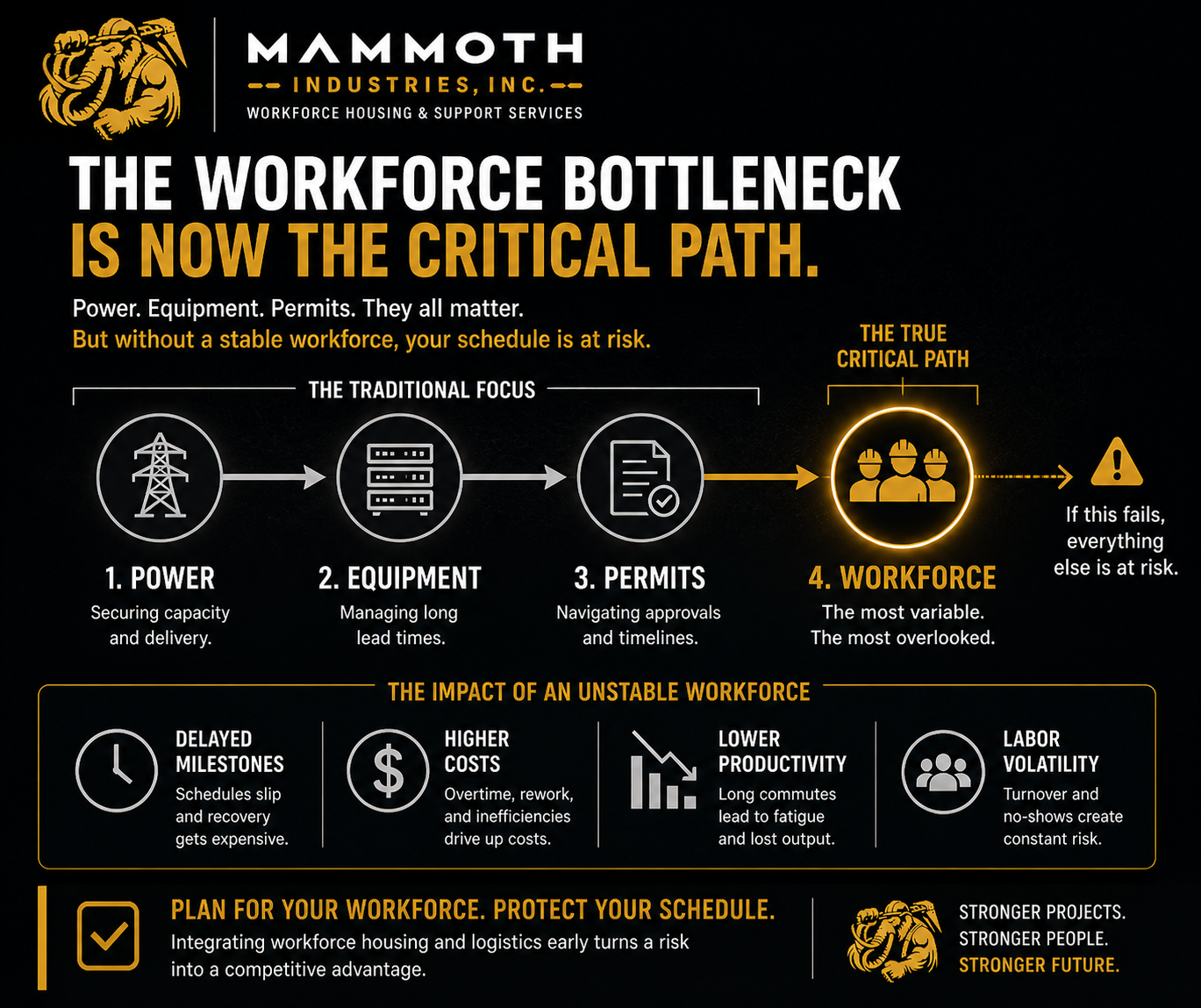
For years, the industry has treated the critical path as a function of:
- Power availability
- Equipment procurement
- Regulatory approvals
These are important. But they are not what’s breaking schedules today.
Across high-growth regions, the real constraint is becoming clear:
Workforce instability.
The Risk No One Is Modeling
Unlike power or equipment, workforce risk is rarely quantified upfront.
But its impact is immediate—and compounding.
When workforce conditions are unstable:
- Crews can’t scale when demand peaks
- Productivity drops due to fatigue and long commutes
- Turnover disrupts continuity mid-build
- Rework and inefficiencies increase
These aren’t isolated issues.
They affect the project every single day.
Why Workforce Proximity Matters
One of the biggest drivers of workforce instability is distance.
When workers are traveling long distances to reach the job site:
- Start times slip
- Energy levels drop
- Retention declines
- Safety risks increase
Over time, this erodes the consistency required to maintain a schedule.
A project may be technically ready—but operationally unstable.
The Shift to People-Ready Sites
Leading developers are beginning to rethink this model.
Instead of asking, “Is this site ready to build?”
They are asking:
“Is this site ready to perform?”
That shift changes everything.
It means aligning:
- Workforce housing
- Transportation access
- Labor scaling strategy
- Site logistics
…before construction begins.
Not as a reaction—but as a requirement.
The Cost of Getting It Wrong
Schedule delays in data center construction are expensive.
Every missed milestone carries downstream impact:
- Delayed revenue from uncommissioned capacity
- Increased labor and operational costs
- Compounded inefficiencies across trades
Many of these delays can be traced back to a single issue:
An unreliable workforce.
Execution Certainty Is the Advantage
The projects that finish on time are not just well-designed.
They are well-executed.
That execution depends on a workforce that is:
- Available
- Proximate
- Stable
- Scalable
Workforce housing and logistics are not support functions.
They are schedule control mechanisms.
The Bottom Line
The industry is evolving.
The definition of the critical path is changing.
And the projects that recognize it first will have the advantage.
Because in today’s environment:
If the workforce isn’t ready, the project isn’t either.
At Mammoth Industries, we support data center construction by enabling people-ready sites—aligning workforce housing and infrastructure logistics to protect the critical path and deliver with certainty.